Structured cabling cost in NYC sits anywhere between $175 and $300 per drop for standard commercial copper – but that range doesn't tell you much without context.
Two offices with the same square footage can get quotes that differ by $30,000.
We’ll break down why: per-drop pricing, total project budgets by space type, the variables that move the number, and the exclusions that cause budget surprises.
Key Notes
Cat6A is the NYC commercial default at $225–$300/drop – Cat6 suits short-horizon retrofits only.
Building conditions can add 15–40% to per-drop cost in NYC.
Skipping TIA-568 certification risks voided warranties and costly re-testing down the line.
Structured Cabling Cost: What You're Paying Per Drop
Structured cabling is priced per drop – meaning per individual cable run, terminated at both ends with a jack, wall plate, and patch panel port. Square footage gets used for rough early estimates, but every real quote is built around drop count.
For NYC Commercial Work In 2026…
The per-drop cost breaks down like this:
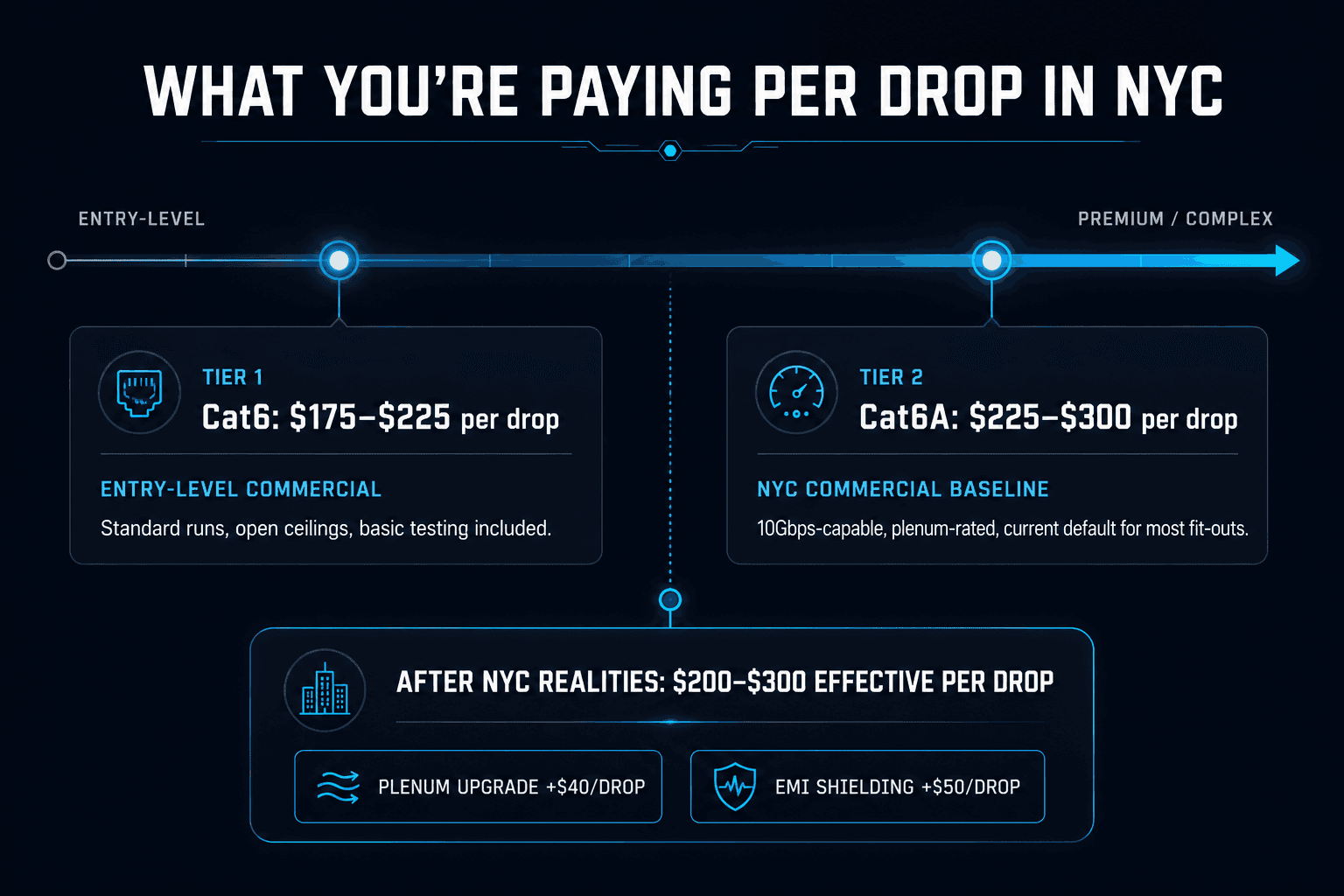
Cat6 (~$175–$225/drop). The entry-level commercial option. Solid-copper cable, workstation jack and wall plate, patch panel termination, labeling, and basic wire-map testing. A NYC starting point for Cat6 is $175/drop for straightforward runs with open ceilings and short pathways.
Cat6A (~$225–$300/drop). The current commercial baseline for most NYC fit-outs. Same inclusions as Cat6, but with 10Gbps-capable cable and the plenum-rated material that most NYC buildings require.
After NYC realities: Plenum cable adds roughly $40/drop where HVAC plenums are involved. Shielding for EMI-heavy spaces adds another $50/drop. Project overhead brings most commercial installations to an effective $200–$300/drop, with volume jobs (30–100+ drops) trending toward the lower end.
One patch cord per drop is usually included (but verify this, because some lower quotes exclude them entirely).
Total Project Cost by Space Type
How much does structured cabling cost at the project level? Here are realistic NYC ranges, assuming Cat6A as the default and a basic rack/patch panel setup included.
Space Type | Typical Drop Count | NYC Budget Range |
Small office (10–25 users) | 15–40 drops | $4,000–$10,000 |
Medium office (25–100 users) | 50–150 drops | $12,000–$40,000 |
Large office (100+ users) | 150–400+ drops | $40,000–$150,000+ |
Retail store | 10–40 drops | $5,000–$20,000 |
Restaurant | 15–50 drops | $7,000–$30,000 |
Warehouse | 20–100+ drops | $10,000–$60,000+ |
Healthcare facility | 50–300+ drops | $25,000–$200,000+ |
Warehouses and healthcare facilities land at the higher end of their ranges because of ceiling access challenges, longer runs, and stricter compliance requirements.
What Drives Structured Cabling Cost Up Or Down?
Drop count sets the baseline. Everything else either compresses or inflates it.
Drop Count vs. Square Footage
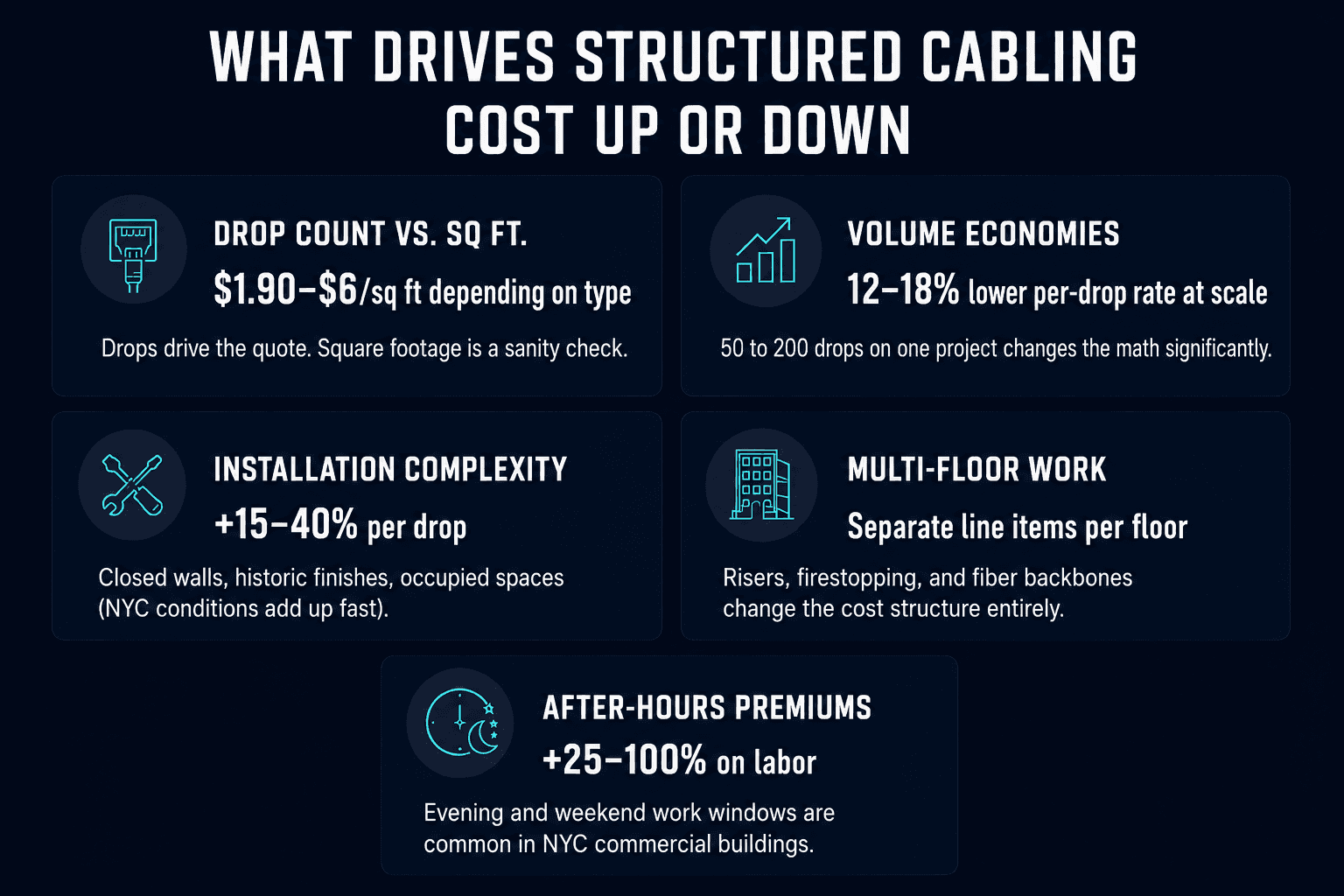
Contractors build estimates around drops, not floor area.
Square footage is useful as a sanity check:
light commercial offices typically run $1.90–$3.50/sq ft equivalent
while healthcare and lab environments often land at $4–$6/sq ft
… but the real lever is how many outlets you need and where they're distributed.
Volume Economies
Going from 50 to 200 drops on a single project can cut the effective per-drop rate by 12–18%. Once a crew is mobilized and pathways are established, incremental drops are cheaper.
This is why adding 10–20% spare drops during a pre-wire phase – while walls are open – is worth doing. Coming back for those same drops as a standalone job later will cost significantly more per drop.
Installation Complexity
This is where NYC diverges sharply from national averages.
Several conditions push per-drop costs up:
Closed walls and finished ceilings. Retrofitting through existing drywall, plaster, or concrete adds 15–30% over equivalent new construction. Every run requires fishing, patching access holes, and often navigating around existing MEP services.
Historic and landmark buildings. Plaster walls, ornate finishes, and severe drilling restrictions can add 25–40% more labor per affected drop. Surface raceway is sometimes the only compliant option.
High ceilings and industrial spaces. Warehouses and loft offices require lifts and additional safety setup for every move. Long overhead runs add both hardware and time.
Occupied offices. Working around staff, managing noise, and staging around meeting rooms reduces crew productivity and often forces after-hours scheduling.
Multi-Floor Work
Once you cross floors, the cost structure changes. Vertical riser pathways, fire-rated penetrations, firestopping sealants, and documentation for inspections all add line items that don't appear on single-floor jobs.
Most multi-floor projects also pivot to a fiber backbone + copper-to-desk design – a small number of fiber riser runs connecting each floor's IDF to the main equipment room, then standard horizontal copper from there.
It's more scalable and often cheaper than pulling large copper bundles between floors.
After-Hours & Weekend Premiums
Many NYC buildings impose strict work windows or require union labor, particularly in CBD towers.
When after-hours work is required, expect evening shifts to run 25–50% above standard labor rates, and weekends 50–100% higher.
Testing, Certification & Documentation
Basic continuity and wire-map testing is included on virtually every professional installation – it confirms connections are wired correctly and the cable is continuous.
Full certification is a different standard.
Full TIA-568 Certification (Fluke-Grade)
Tests each permanent link against category performance standards: insertion loss, NEXT/PSNEXT, ACR-F, return loss, and length verification. Every link gets a pass/fail result with margin data.
The cost is around $20–$25/drop as an add-on, and it's worth it for most commercial installations.
Why Certification Matters Beyond The Upfront Cost:
Manufacturer warranties often require certified test results. Without them, extended hardware warranties can be voided.
Future tenants inherit your cabling. Certified, documented cabling gets reused. Undocumented cabling gets ripped out – wasting the original capital investment.
Troubleshooting on a certified, labeled plant takes hours. On an undocumented one, it can take days and require re-testing hundreds of lines.
At Handover, Insist On:
a full set of certification reports (pass/fail per link, cable IDs, test standard, date)
a port map tying every faceplate label to a patch panel port
a basic as-built diagram showing telecom room locations and backbone routes
Those documents turn a cabling plant into an asset. Without them, the next person working on the building starts from scratch.
Ready To Budget Your Cabling Project Accurately?
Licensed installers, free site visit, itemized quote.
Structured Cabling Cost FAQs
How long does structured cabling installation take in NYC?
Most structured cabling installations in NYC take one to three days for a standard commercial office, depending on drop count and building access. Larger multi-floor projects or buildings with restricted work windows can run longer – your contractor should confirm a timeline after the site walkthrough.
Do I need a permit for structured cabling installation in New York City?
Low-voltage structured cabling typically does not require a DOB permit in New York City. However, any associated electrical work, core drilling through fire-rated assemblies, or construction modifications may require permits from other trades.
What is the difference between structured cabling and network cabling?
Network cabling refers specifically to the cables connecting devices to a network, while structured cabling is the complete, standardized infrastructure system – patch panels, racks, pathways, terminations, and all horizontal and backbone cabling – that network cabling runs through. In commercial installations, structured cabling is the broader build; network cabling is one component of it.
How many data drops do I need for my office?
A standard commercial office typically plans for two drops per workstation – one for data, one as a spare or for VoIP – plus additional drops for Wi-Fi access points, printers, security cameras, and any AV equipment. A site assessment is the most reliable way to confirm the right count for your specific layout.
Conclusion
Structured cabling cost in NYC comes down to a handful of variables that don't show up in national averages: plenum requirements, building age, occupied-space constraints, landlord work windows, and what your contractor excludes from the base quote.
Cat6A is the right call for most commercial fit-outs – the cost delta over Cat6 is small, the lifecycle difference is not. Volume helps, retrofits cost more than new construction, and multi-floor work is its own budget category.
The number that matters is the one built around your specific building. An on-site assessment from a licensed NYC cabling contractor is the fastest way to move from ranges to a real figure – book a free appointment to get yours.
Pricing figures referenced in this guide are based on NYC commercial market data current as of 2026 and are intended for budgeting purposes only. Actual costs vary depending on building conditions, scope, cable specification, and contractor. All figures should be treated as planning ranges, not fixed quotes. Contact a licensed low-voltage contractor for an accurate assessment of your specific project.