NYC retail security system cost depends on a lot more than square footage – the same $8,000 budget gets a boutique locked down tight or barely covers cameras for a mid-size grocery.
Prices range from around $2,000 for a small professionally installed setup to $50,000+ for high-risk or large-format stores, with $40–$300/month in ongoing costs on top.
We’ll break down every cost variable: store size, store type, equipment, installation, and monthly fees.
Key Notes
Store size sets the baseline – layout, risk profile, and building age move the number.
Equipment accounts for 60–80% of upfront cost.
Ongoing costs run $40–$300+/month depending on monitoring, software, and store size.
Retail Security System Cost By Store Size
Store size is the most reliable starting point for estimating retail security system cost in NYC.
Larger footprints mean more cameras, longer cable runs, bigger NVRs, and more time on-site. Here's what the numbers look like across four size bands:
Store Size | Typical Install Cost | Camera Count | Alarm Config | Monthly Costs |
Under 1,000 sq ft | $2,000–$5,000 | 4–6 cameras | 1 panel, 2–4 contacts, 1–2 motions | $40–$100/mo |
1,000–3,000 sq ft | $3,500–$10,000 | 6–10 cameras | 1–2 keypads, 4–8 contacts, optional glass-break | $60–$150/mo |
3,000–10,000 sq ft | $7,500–$25,000 | 10–20 cameras | Multi-zone panel, 6–12 contacts, 1–2 access doors | $100–$300/mo |
10,000+ sq ft | $15,000–$50,000+ | 20–40+ cameras | Enterprise panel, multi-keypad, multi-door access control | $200–$500+/mo |
Two Stores The Same Size Can Get Very Different Quotes
A compact 4,000 sq ft space with clean sightlines can cost less than a 2,000 sq ft store with corridors, back rooms, and a complex layout. Size is the starting point – not the whole story.
What Drives Retail Security System Cost?
The variables that move a retail security system quote up or down most significantly have less to do with brand of hardware and more to do with your building and your risk profile.
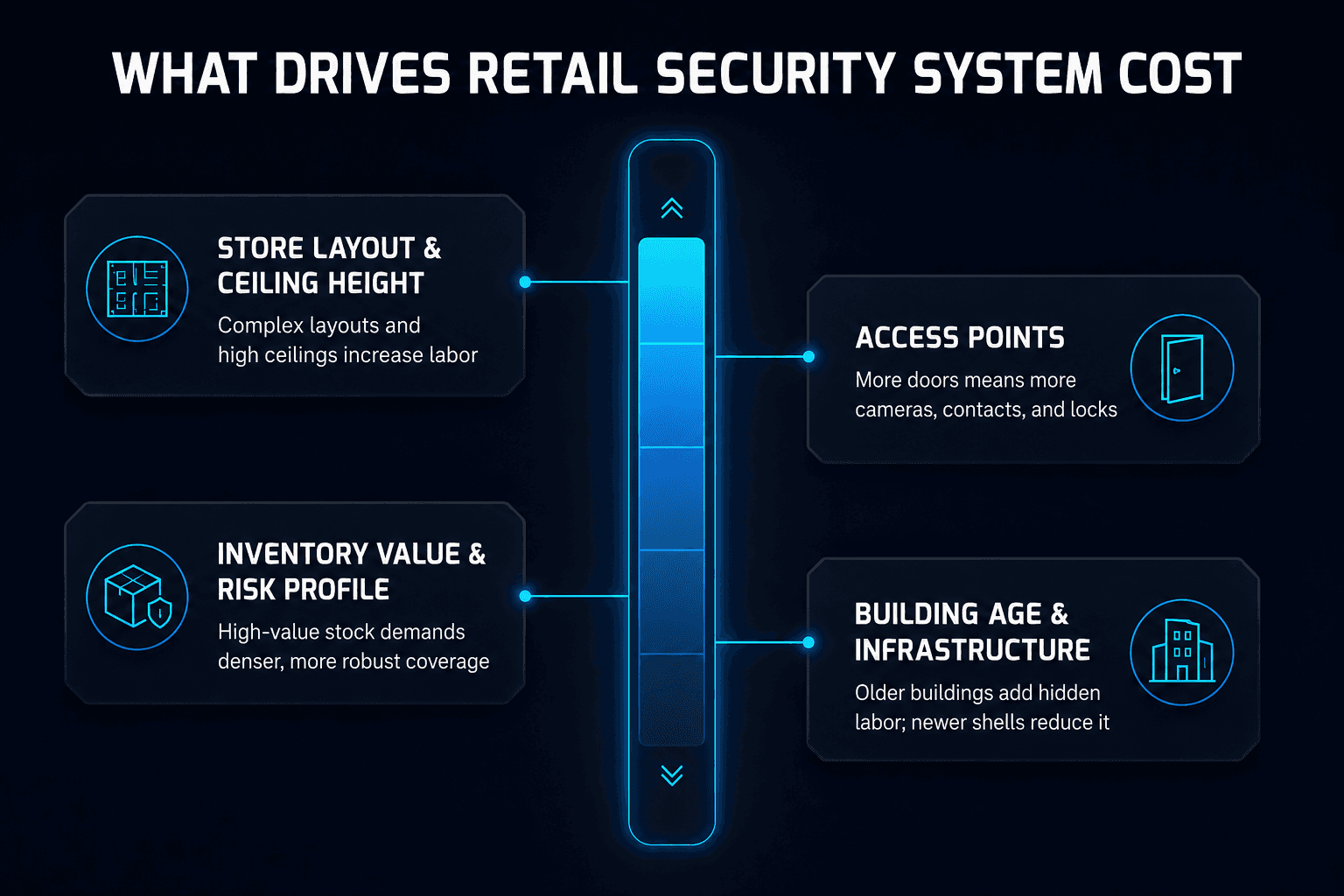
Store Layout & Ceiling Height Are The Two Biggest Labour Multipliers
Obstructed sightlines – tall shelving, columns, narrow aisles – increase camera count because each blind spot needs its own coverage. High ceilings require lift equipment, which adds hours and cost per device.
The same camera count in a low-ceiling boutique will cost less to install than in a tall-ceilinged flagship.
Number Of Access Points Matters More Than Floor Area In Some Cases
Every entrance and exit needs coverage and control – more doors means more cameras, more door contacts, and potentially more access-controlled locks. A single-entry boutique is cheaper to secure than a similar-sized store with a public front, staff side door, and loading bay.
Risk Profile & Inventory Value Shape How Robust The System Needs To Be
High-value, high-resale inventory (electronics, pharmaceuticals, designer goods) justifies denser camera coverage, stronger access control to stockrooms, and often live or video-verified monitoring.
Lower-risk, lower-value inventory may need solid perimeter deterrence and basic coverage without enterprise-level layers.
Neighborhood crime rates also feed into system design – higher-risk areas often prompt insurers or landlords to mandate specific levels of coverage, which drives up both upfront and recurring costs.
Building Age & Existing Infrastructure Can Swing A Budget In Either Direction
Older NYC buildings often require surface-mounted conduit, creative cable routing, and sometimes electrical upgrades to support PoE cameras – all of which add labor hours not obvious from an initial walkthrough.
Conversely, a newer shell with existing conduit, cable trays, and network infrastructure can cut installation time significantly.
Retail Security System Cost – Equipment Breakdown
For most retail projects, equipment accounts for roughly 60–80% of the upfront investment.
Here's what each component typically costs in NYC:
Security Cameras
Usually the biggest line item.
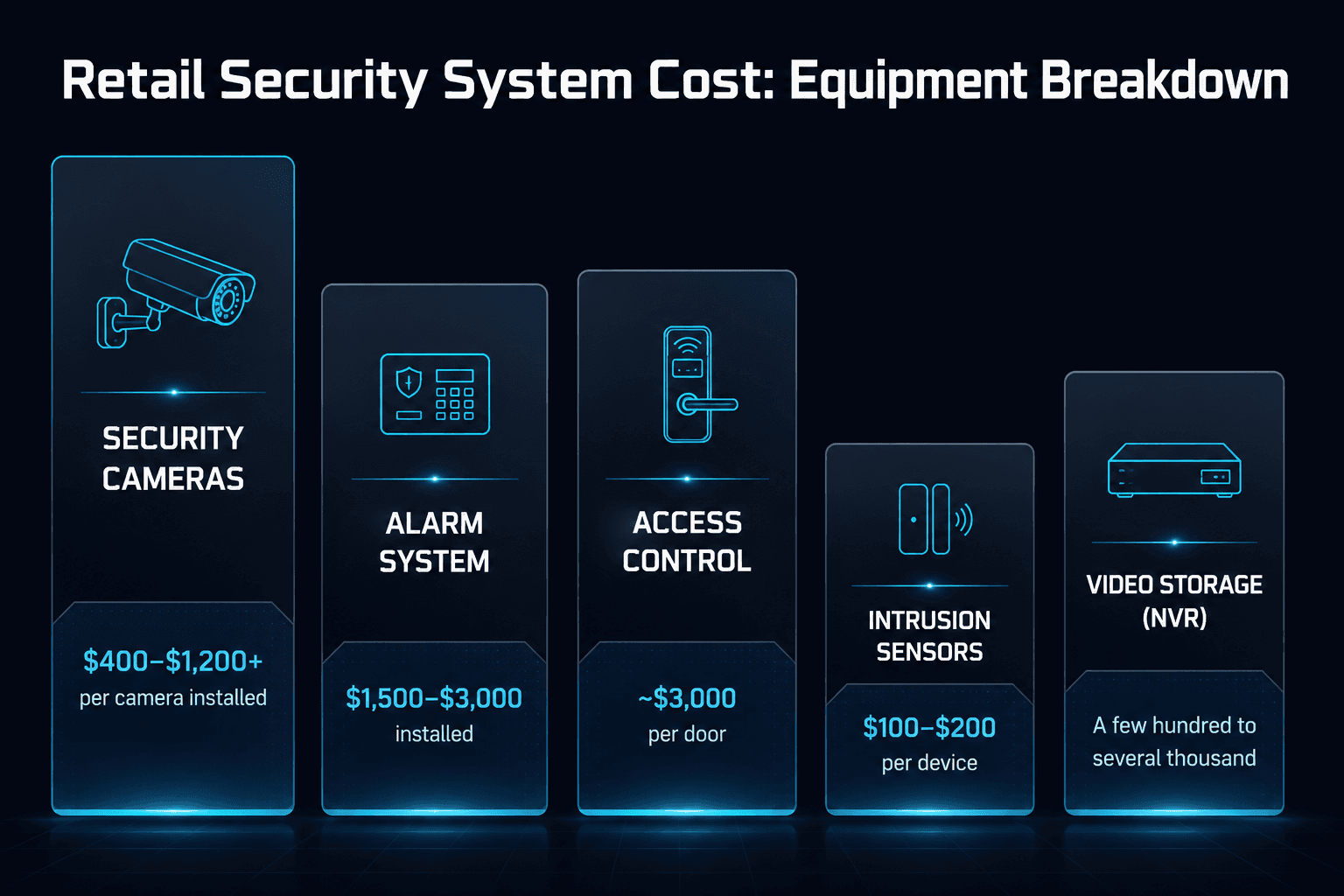
Standard fixed IP cameras – domes, bullets, turrets – run around $400–$800 per camera installed, factoring in hardware, mounts, cabling, and labor.
Higher-resolution or specialty cameras (4K, multi-sensor, ruggedized) come in at $800–$1,200+ installed.
PTZ cameras are a different bracket entirely at $1,500–$4,000 per unit – they make sense for large open floors or high-risk display areas, but for most stores a grid of fixed cameras delivers more reliable coverage.
Most retailers need somewhere between 4 and 20 cameras.
Alarm Systems
For small commercial spaces typically cost $1,500–$3,000 for equipment and installation.
That covers a control panel, keypad, internal siren, cellular communications module, door and window contacts, and motion detectors.
Monitoring adds $40–$120/month on top.
Access Control
Runs around $3,000 per door for a full commercial access control setup – reader, lock, power supply, controller, and labor. Smart locks are cheaper ($300–$800 in hardware) but offer less robustness for high-traffic or multi-staff environments.
Most retailers apply access control selectively: stockrooms, cash offices, employee-only corridors.
Intrusion Sensors Are Relatively Low Cost On Their Own
Door/window contacts: $100–$200 installed per contact
PIR motion sensors: low hundreds per device
Glass-break detectors: similar range, per protected zone
Video Storage
Typically handled by a local NVR, bundled into the camera quote.
Entry-level NVRs add a few hundred dollars.
Larger multi-drive systems for higher retention scale up from there.
Cloud storage is increasingly offered as a hybrid add-on, priced per camera per month.
Retail Security System Cost – Installation
Installation typically accounts for 20–40% of total project cost on a retail security system.
For simpler jobs, NYC integrators quote roughly $300–$700 in labor on a small system, but that number climbs fast once complexity enters the picture.
What Increases Labor Time & Cost:
High ceilings requiring lift equipment rather than step ladders
Older buildings where cable must be fished through walls or run in surface conduit to protect finishes
Complex layouts with many small rooms, long cable routes, or multiple floors
After-hours installs – evenings and weekends carry a labor premium, sometimes with explicit surcharges, though most NYC providers offer this to avoid disrupting trade hours
What Brings It Down:
Open layouts with clear sightlines and short cable runs
Existing conduit, cable trays, or structured cabling that can be reused
New-build or recently fitted shells where cabling was run before ceilings closed
On Timelines:
Most small NYC stores are wired up in one to two days.
Medium stores with more cameras and some access control typically run two to four days on-site.
Large or multi-floor spaces can take a full week or more.
Major corporate rollouts often involve three to four weeks of total project time when you factor in design, approvals, and sequencing.
Retail Security System Cost: Ongoing Monthly Costs
Retail security system cost per month is a separate budget line from the upfront install (and one that often gets underestimated).
For a single-location store, most of the monthly spend falls into three buckets:
Professional Monitoring Is The Baseline
Central-station alarm monitoring for a commercial retail site typically runs $40–$120/month, covering 24/7 signal handling, emergency dispatch, cellular backup communications, and basic remote access via app.
Video verification and opening/closing reports can push that higher.
Cloud And Software Subscriptions Add Up Faster Than Expected:
Cloud video storage is priced per camera per month – a reasonable range is $5–$25/camera depending on resolution, recording mode, and retention period.
VMS or video management platforms charge per camera or per site for remote access, multi-site dashboards, and user management.
Access control platforms (Brivo and similar) typically bill per door and/or per user per month for credential management, access logs, and mobile credentials.
Annual Maintenance Is Modest But Real
Budget at least one service visit per year for a small store – a few hundred dollars as a baseline – plus a contingency for the occasional device replacement.
Hard drives, camera hardware, and sensor batteries wear out, particularly in busy NYC retail environments.
Retail Security System Cost By Store Type
Store category is a useful lens because risk profile, insurance requirements, and typical configurations vary significantly by what you sell.
Below are realistic installed cost ranges for common NYC retail formats:
Convenience stores: High cash volume, late hours, repeat incidents. Expect 6–12 cameras, panic buttons, monitored alarm. $5,000–$15,000.
Clothing stores: Fitting room coverage, stockroom access, seasonal footfall. 6–12 cameras, basic access control. $4,000–$12,000.
Jewellery stores: High-value items, strict insurer mandates, duress buttons, vibration sensors. Often $15,000–$50,000+ for a properly spec'd setup.
Grocery stores: Large floor areas, receiving risks, high footfall. 16–40+ cameras, multi-zone alarm, back-of-house access control. $10,000–$40,000.
Liquor stores / pharmacies: High-resale inventory, robbery risk, regulatory oversight. Camera-dense, panic buttons, controlled stockroom access. $6,000–$30,000+.
Electronics stores: Organized retail crime, dense display coverage, strong stockroom access control. $10,000–$30,000 for mid-sized stores.
Luxury retail: Flagship-level spec, guard integration, corporate security platforms. $20,000–$50,000+.
Pop-up and mall stores: Leaner installs, sometimes temporary mounting. Pop-ups typically $2,000–$7,500; inline mall stores $4,000–$15,000.
Hidden Retail Security System Cost Most Retailers Don't Plan For
The quoted number is rarely the final number.
A few cost categories that consistently catch retailers off guard:
Change Orders During Installation
Blind spots discovered mid-install, extra contacts needed, additional panic button locations – each is a small add-on in hardware and labor, but they accumulate.
Backend reprogramming and zone changes can also attract service fees post-install.
Building Infrastructure Surprises
Older NYC buildings often require additional power infrastructure – PoE switches, UPS units, additional outlets – that isn't obvious at the survey stage. These can add hundreds to thousands to a project that looked straightforward on paper.
False Alarm Fines
Poorly configured or outdated systems generate false dispatches, and NYC fines for repeated false police calls.
The staff time handling nuisance alarms adds soft cost on top of that.
Software & Licence Creep
Cloud platforms charge per camera, per door, or per user. As you add locations, staff, or analytics features, recurring OpEx grows – sometimes significantly.
It's worth mapping out the five-year software cost before committing to a platform.
The Cost Of Under-Speccing
This one doesn't show up on a quote at all. Gaps in coverage, low-resolution footage, and out-of-service devices increase shrink, raise insurance risk, and weaken any evidence you'd need for a claim or prosecution.
The financial impact of a weak system often outweighs whatever was saved by cutting corners on the original install.
How Much Should Your Store Really Be Spending?
Get a free on-site assessment and a tailored system design.
Retail Security System Cost FAQs
What is the best security system for a retail store?
The best retail security system covers your entrances, POS, high-theft areas, and stockroom with IP cameras, a monitored alarm, and selective access control on back-of-house doors. There's no universal answer – the right configuration depends on your store size, inventory value, and risk profile.
Can a new security system integrate with my existing cameras?
In most cases, yes – a professional integrator can assess whether your existing cameras are compatible with a new NVR or VMS platform. If the hardware meets current performance standards, reusing it can reduce upfront cost meaningfully.
How much does retail security system monitoring cost per month?
Retail security system monitoring costs typically run $40–$120 per month per site for professional central-station service. Higher-risk stores or those adding video verification, cellular backup, or opening/closing reports will sit toward the upper end of that range.
What anti-theft devices do retail stores use?
Most NYC retailers combine monitored intrusion alarms, IP cameras with POS coverage, and access-controlled stockroom doors as their core loss prevention setup. Electronic article surveillance (EAS) tags and gates are a separate retail-specific layer that some stores add on top of their security system infrastructure.
Conclusion
Retail security system cost in NYC spans a wide range (and that range exists for good reasons).
Store size sets the baseline, but layout complexity, ceiling height, inventory risk, building age, and the number of access points all push the final number in different directions. Two stores the same size can end up with quotes that look nothing alike.
The other thing worth carrying away: the upfront install is only part of the budget. Monitoring, software subscriptions, and maintenance are real ongoing costs that compound over time, especially as systems scale or add cloud features.
Getting the system design right from the start – sized correctly, specced for your risk profile – tends to cost less over five years than fixing an under-built one. If you want a clear picture of what an integrated security system would look like for your specific space, book a free on-site assessment.
All cost figures in this guide are estimates based on typical NYC market rates at the time of publishing and are intended for budgeting reference only. Actual retail security system costs vary based on store size, layout, building conditions, hardware specifications, and project scope. Figures do not constitute a quote or formal proposal. Contact Highline Integrated Security for an accurate assessment tailored to your property.