Motion sensors have quietly become part of everyday life – turning on lights as we walk through a hallway or triggering cameras that keep properties safe.
But beyond the convenience, they play a vital role in modern security and automation.
Ever wondered how they detect motion or why there are so many different kinds? We’ll break down exactly how motion sensors work, their main types, and what they’re used for.
Key Notes
PIR sensors detect heat changes, while microwave sensors use radio waves and Doppler effect.
Dual-technology sensors combine PIR and microwave to reduce false alarms dramatically.
Proper placement is 7-8 feet high away from vents, which prevents temperature-triggered false positives.
How Do Motion Sensors Work?
Every motion sensor works by monitoring a specific type of energy or signal and reacting when it changes unexpectedly.
Some detect heat (infrared), others detect changes in reflected sound or radio waves, and some use computer vision to interpret visual data.
The key distinction is between passive and active sensors:
Passive sensors (like PIR) only receive signals – they detect natural energy emitted by people or objects.
Active sensors (like microwave or ultrasonic) emit their own signals and monitor how those signals bounce back.
When motion is detected, the sensor generates an electrical pulse that tells a connected system – such as an alarm, light, or smart device – to take action.
Main Types of Motion Sensors & How They Work
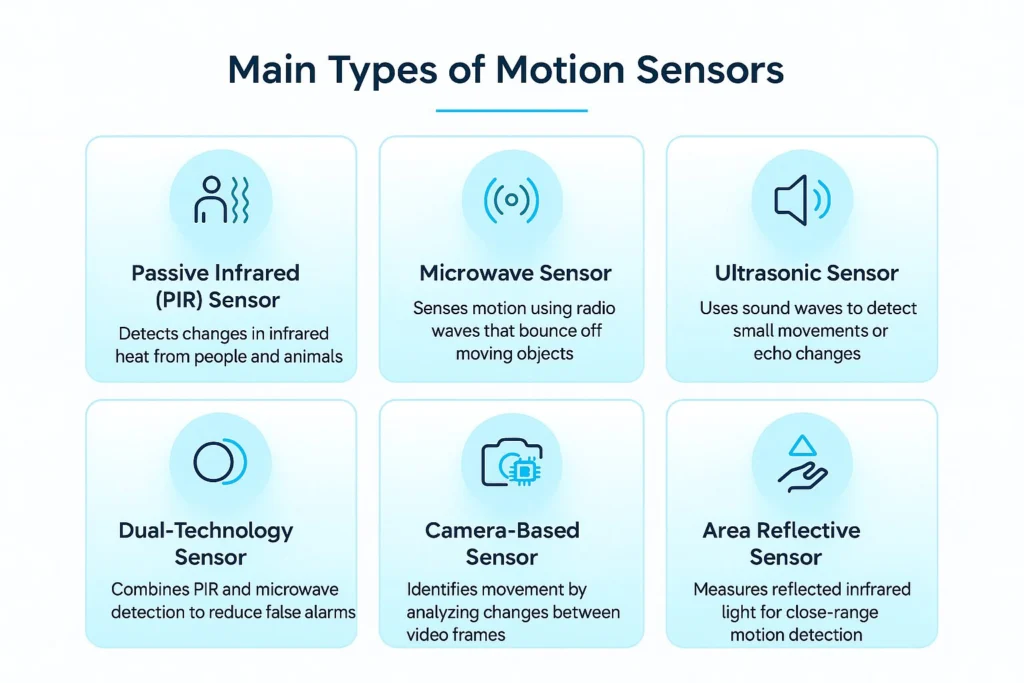
1. Passive Infrared (PIR) Sensors
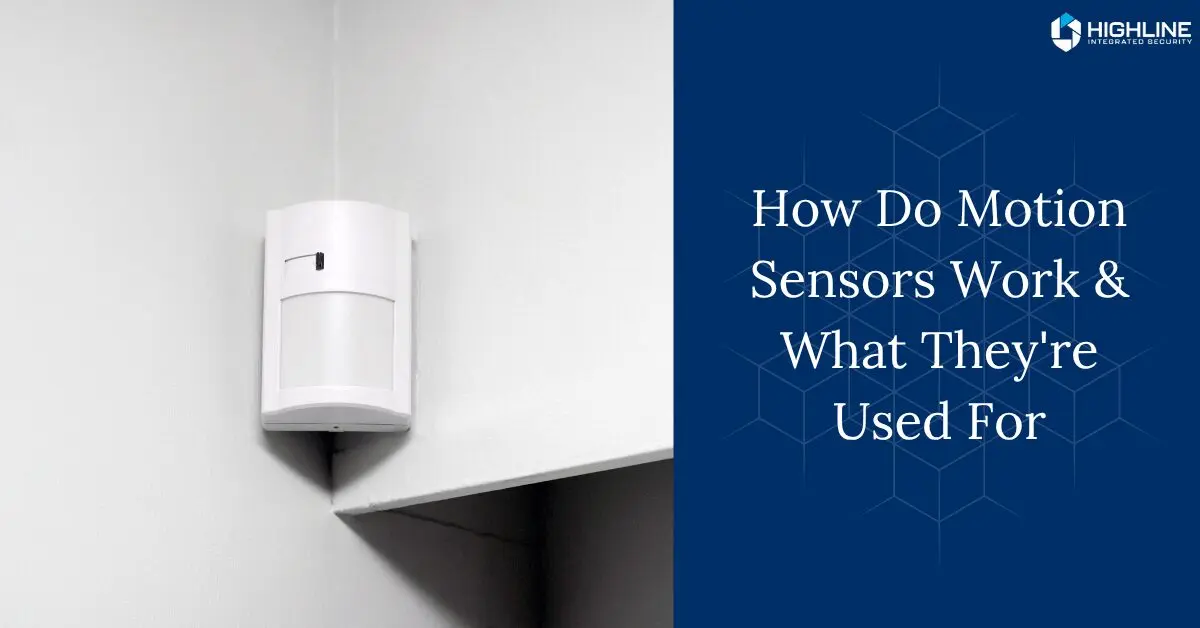
PIR sensors are the most common type found in homes and offices. They detect motion by sensing changes in infrared radiation (heat energy) from warm objects like people and animals.
Each PIR sensor has pyroelectric elements divided into zones. When a warm body moves across these zones, the sensor registers a sudden change in infrared energy between one segment and another.
This change creates a small voltage signal, which triggers the system.
Pros: Low power use, reliable indoors, affordable, unaffected by light levels.
Cons: Limited range; can’t detect through walls or glass; sensitive to sunlight or HVAC drafts.
Best for: Indoor motion detection, lighting control, and basic alarm systems.
2. Microwave Sensors
Microwave sensors emit low-power radio waves and measure how those waves bounce back.
When something moves, it causes a frequency shift in the returned signal – a phenomenon known as the Doppler effect. The sensor interprets that shift as motion.
Pros: Can cover larger areas than PIR and detect motion through some materials (like drywall or glass).
Cons: Higher power consumption and more prone to false alarms if not properly calibrated.
Best for: Commercial spaces, parking lots, and outdoor perimeter protection.
3. Ultrasonic Sensors
Ultrasonic sensors emit sound waves above the range of human hearing and listen for changes in the echo. When movement disrupts the echo pattern, it’s detected as motion.
Pros: Excellent sensitivity to small movements; unaffected by lighting.
Cons: Can trigger false alarms from airflow, fans, or vibrations; short range; sound reflections vary in irregular rooms.
Best for: Office automation, lighting control, and HVAC optimization.
4. Dual-Technology (Dual-Tech) Sensors
These combine two technologies (usually PIR and microwave) so both must be triggered to activate the system. This dramatically reduces false alarms.
Pros: Reliable and accurate, ideal for pet-friendly systems or sensitive environments.
Cons: Slightly more expensive and complex to install.
Best for: Commercial security, mixed indoor-outdoor spaces, and properties with pets or high movement variability.
5. Camera-Based (Image or AI) Motion Sensors
Rather than measuring energy changes, these use video data. They detect motion by analyzing differences between video frames.
Advanced models use AI to distinguish between humans, vehicles, pets, or shadows.
Pros: Provide visual confirmation and can trigger smart responses or alerts.
Cons: Higher cost, privacy considerations, requires lighting or night vision.
Best for: Security camera systems, smart home monitoring, and analytics-driven commercial setups.
6. Area Reflective and Specialty Sensors
Some motion sensors use infrared light reflection or magnetic changes to detect very short-range movement.
For example, the sensor on an automatic faucet or a touch-free entry door uses reflected infrared light to determine proximity.
Best for: Touchless controls, doorways, smart appliances, and short-range automation.
Choosing the Right Sensor
The best motion sensor depends on where it will be used and what you’re trying to detect.
A small PIR in a hallway is great for turning on lights but useless in a warehouse or outdoor yard.
Consider:
Environment: Indoor vs. outdoor, presence of sunlight, temperature fluctuations.
Range and Coverage: Wider spaces benefit from microwave or dual-tech sensors.
False Alarm Tolerance: For pet-friendly homes or busy offices, dual-tech or AI-based systems are worth it.
Privacy: Use non-camera sensors in private or residential areas.
For example, a luxury brownstone might use PIR sensors in hallways and staircases for lighting, while a commercial complex could use microwave or camera-based systems for entry points and parking garages.
How Motion Sensors Integrate Into Security Systems
Modern motion sensors rarely operate alone. They integrate with alarms, cameras, access control, and automation systems.
With Alarm Systems: Motion triggers can sound sirens or silently alert monitoring centers.
With Cameras: Motion events activate recording or AI verification to prevent false alarms.
With Access Control: Sensors detect unauthorized after-hours movement and lock down zones.
With Lighting and HVAC: Occupancy-based control saves energy by only running systems when needed.
With Smart Home Systems: Integrate via apps to control lights, thermostats, and more from anywhere.
Reducing False Alarms and Missed Detections
Even the best systems can struggle with accuracy if sensors aren’t properly installed or calibrated.
Common causes of false positives include:
Sudden temperature changes (sunlight or air vents)
Pets, insects, or moving drapes
Electrical interference or reflective surfaces
To minimize false alarms:
Mount sensors 7–8 feet high, angled away from windows and vents.
Clean lenses regularly and keep the field of view clear.
Use dual-technology sensors to verify motion with two independent systems.
For camera-based setups, apply AI filters to ignore environmental noise.
False negatives (missed detections) often stem from poor placement or low sensitivity settings. A professional installer ensures correct alignment, sensitivity calibration, and environmental tuning for your space.
Maintenance and Longevity
Motion sensors are low-maintenance but not maintenance-free. Dust buildup, loose wiring, or outdated firmware can impact performance.
Schedule regular checks – especially in commercial spaces.
Routine tasks include:
Cleaning sensor lenses
Checking alignment and range
Testing integration with alarms or cameras
Updating firmware for smart or AI-based sensors
A typical sensor lasts 5–10 years, but professional inspection ensures they continue to perform at their best.
Privacy and Security Considerations
Camera-based sensors bring immense capability, but also added responsibility. Continuous monitoring means handling sensitive data, which should always be encrypted, securely stored, and accessible only to authorized users.
For properties like museums, offices, or residences, privacy laws and public comfort must be respected. Non-visual motion sensors remain an excellent alternative for these environments.
Is Your Property Truly Covered Everywhere?
Eliminate blind spots with expertly placed motion detection.
Frequently Asked Questions
How far can a motion sensor detect movement?
Detection range varies by type. Most indoor PIR sensors cover 20–35 feet, while microwave sensors can reach up to 100 feet or more. Always check the manufacturer’s specs and consider your room layout before installation.
Can motion sensors work outdoors in extreme weather?
Yes – but outdoor-rated sensors are designed with protective housings and temperature compensation to handle rain, humidity, and heat. Using indoor sensors outside often leads to false alarms or reduced lifespan.
Are motion sensors safe around Wi-Fi, pets, or people with medical devices?
Yes. The radio or infrared energy levels they emit are extremely low – far below anything that could cause interference or harm. They’re considered completely safe for home and commercial use.
Do motion sensors consume a lot of power?
Not at all. PIR sensors use minimal energy (a few milliwatts). Even active types like microwave or ultrasonic sensors are energy-efficient, especially when integrated with smart systems that power down when idle.
Conclusion
Motion sensors have become essential to how we secure and automate our spaces.
Whether they’re quietly managing lights in a hallway or monitoring a commercial property after hours, they all work on the same principle – detecting changes in energy and responding instantly.
From simple passive infrared units to advanced camera-based systems, choosing the right motion sensor depends on your environment, range needs, and tolerance for false alarms.
Regular maintenance, correct placement, and professional calibration ensure reliable detection year after year.
If you’re looking to install or upgrade your motion sensors, book a free appointment to get expert guidance on placement, setup, and integration for dependable, efficient protection that fits your property’s needs.